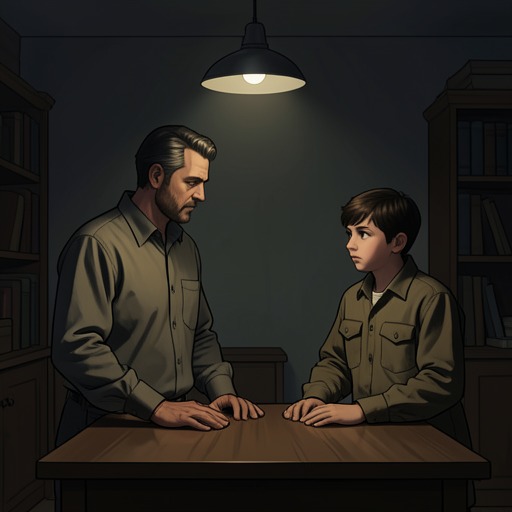
Sanae returns home and reconciles with her father
Even If This Love Disappears From the World TonightSanae’s return home and reconciliation with her father mark a turning point in the Kamiya family’s long estrangement: not a sudden erasure of old injuries, but the first visible movement toward a relationship in which both can acknowledge what they owe one another. The change begins with a late-night telephone call, reaches its clearest expression in a visit about ten days later, and is carried by modest acts—cleaning, cooking, exchanging books, and smiling together—that make reconciliation a practice rather than a declaration.
Background and the First Call
The call comes after Tooru and his father have begun to face the truth they had avoided. They had not been speaking openly about their family, but the recognition that avoidance did not make either of them bad allows a tentative warmth to return between father and son. Near ten o’clock, after they finish washing the dishes, the household landline rings—an unusual occurrence. The father looks puzzled, then realizes who might be calling and glances at Tooru. Tooru nods; his father picks up the receiver nervously.
When he hears Sanae’s voice, he addresses her by name. Tooru moves to the window and opens it, leaving his father and sister to speak privately for the first time in years. The father apologizes, calling himself a bad father and accepting that he is the one who needs to say he is sorry. He also recognizes that the day is special for Sanae. The conversation’s emotional peak is his congratulations, delivered with tears in his voice: he congratulates her from the bottom of his heart. Tooru looks up at the sky and cries a little. Sanae is not yet in the house, but the call has already altered its emotional atmosphere.
The Visit and a Changed Household
About ten days after the announcement of Sanae’s prize, she visits home. Her first remark praises the house’s neat appearance and teases Tooru as her little brother. The welcome she encounters is different from the household she left: her father has been in high spirits since their second telephone conversation, and, beginning the morning after the first, has taken part in the chores. He has tried cooking, made mistakes, and tried again with Tooru’s help. On the day Sanae arrives, he has been cleaning since morning and boasts that he plans to cook dinner.
Tooru makes sure his sister knows the change is not his work alone: their father has been helping, too. Sanae is genuinely surprised. The father, bashful as he explains that he has turned over a new leaf, says he has found cooking and cleaning enjoyable once he has tried them. These ordinary tasks give the reconciliation a material form. His role in the home is no longer limited to writing while Sanae bears the household responsibilities; he is learning, imperfectly and with Tooru’s assistance, to participate in its upkeep.
The father also tells Sanae that he intends to take a break from writing. He insists that the pause is not an escape: he wants to wait until he can face himself in his writing and then begin again. In the same conversation, he invites her to take any books she wants, including first editions, because he needs to pare down his collection. The offer joins a practical change in the house to a more difficult reckoning with his former priorities and his identity as a writer.
Writing, Inheritance, and Recognition
Sanae’s answer reveals how closely her own ambitions were shaped by the father from whom she had become estranged. She tells him that he was the reason she began writing: watching him write novels at close quarters showed her what a writer’s life could be. At first, she says, she wrote as he had, to escape reality. Later, she came to see writing differently—as a means of growing, and of encountering new words and ideas of her own. Her account does not simply praise her father; it distinguishes the use she once shared with him from the purpose she has since found for herself.
The father is silent and appears moved almost to tears. Sanae then shifts to a cheerful tone, easing the intensity by returning to the book collection. She jokes that the house has too many books and is not very sanitary, and says she will take him up on the offer to bring some home. He agrees. When she asks whether he is sure and warns that she will be merciless, the two grin at the same moment. Their shared smile gives the scene a small, reciprocal culmination: he has acknowledged her achievement and offered her books; she has acknowledged his influence and accepted what he is willing to give.
Limits and Significance of the Reconciliation
The scene does not present the family’s history as settled. Tooru explicitly recognizes that all the bad blood has not disappeared. His father had chosen novel-writing over fatherhood, while Sanae took over the household for him despite knowing that his dream was not coming true, before eventually choosing a writer’s path herself. Both carry guilt about what they did and the roles they occupied. The visit does not undo those circumstances or resolve every consequence of them.
What changes is their direction. Despite the lingering guilt, father and daughter smile and try, each in a different way, to move forward. The father’s new participation in cooking and cleaning, his decision to pause until he can write honestly, and his willingness to let Sanae take books from his collection all make that effort concrete. For Tooru, who witnesses the call and the visit, the reconciliation also makes visible how a family can begin to recover without pretending that its past has vanished. The return home is not a return to the old arrangement; it is the beginning of a more mutual one, built from apologies, recognition, and actions that can be repeated.